Unitree’s new “all terrain” wheeled robot is more than just a flashy clip on the internet; it’s a clear marker of how quickly ground robotics is evolving from laboratory curiosities into serious, physically capable machines that can operate where traditional vehicles and many humans struggle. This blog walks through what this robot is, how it moves, what it can be used for, and why its arrival matters far beyond one company’s product launch.
A New Kind of All-Terrain Robot
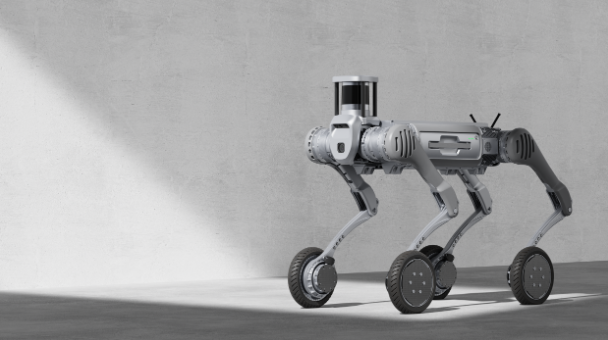
The robot everyone is talking about is Unitree’s Super Athlete AS2‑W, a wheel‑leg hybrid quadruped built by the Chinese robotics firm Unitree Robotics. At first glance, it looks like a compact four‑legged “robot dog,” but there’s a crucial twist: each leg ends in a powered wheel. Instead of choosing between wheels or legs, the AS2‑W combines both in one body.
On flat ground, the robot rolls like a high‑speed wheeled vehicle, reaching up to 6 m/s, which is over 21 km/h. When it encounters stairs, rocks, steep slopes, or debris, the legs take the lead; the robot climbs, hops, and adjusts its posture to stay stable and keep going. In demonstration videos, the machine runs across concrete, scrambles up near‑vertical rocky paths, jumps down ledges, and even wades through shallow streams without hesitation.
This hybrid design addresses a long‑standing mobility trade‑off. Traditional wheeled robots are fast and energy‑efficient but struggle with complex terrain. Pure legged robots handle rough ground well but often move slower and use more power. By fusing wheels with legs on a quadruped chassis, Unitree is pushing toward a best‑of‑both‑worlds solution.
The Hardware: Compact Body, Strong Joints
The numbers behind the AS2‑W make the videos easier to understand. Official specs and detailed coverage highlight the following:
- Weight: Around 25 kg with battery installed.
- Dimensions: Roughly 72–76 cm long, 49–60 cm wide, and just over 50 cm tall, depending on configuration.
- Motors and joints:
- 16 low‑inertia drive motors with 16 degrees of freedom for the legs and wheels.
- Industrial cross‑roller bearings and peak joint torque around 95 Nm.
- Wheels: 7‑inch wheels (178 mm diameter, 50 mm radius) at the end of each leg.
This hardware combination gives the robot the strength and responsiveness needed for sudden accelerations, jumps, and aggressive maneuvers on uneven terrain. With high torque joints and relatively large wheels, the AS2‑W can lift itself, absorb impacts, and propel forward even when one or more legs are dealing with obstacles or gaps.
Environmental resilience is another key point. The robot’s body is rated IP54, offering protection against dust and splashing water, and it operates between about ‑20 °C and +55 °C, making it suitable for a wide range of outdoor conditions. These ratings show that the machine is designed for real field use, not just indoor demonstrations.
Power and Endurance: How Far It Goes
Mobility is only useful if the robot can stay powered long enough to complete meaningful tasks. Unitree equips the AS2‑W with a 648 Wh battery (around 15,000 mAh), paired with support for fast charging. Reported endurance figures look like this:
- Unloaded:
- Over 3 hours of runtime.
- More than 30 km travel on level ground or mixed terrain.
- With 16 kg payload:
- More than 2 hours of runtime.
- Around 16–25 km range, depending on conditions.
The robot distinguishes between static load and continuous walking payload. It can support a standing load up to 150–180 kg, but while walking it is rated for a continuous payload of about 16 kg. This distinction matters in practical deployments: the robot can be used as a compact cargo carrier, but heavy loads will reduce range and should be managed with mission planning.
These endurance and payload figures position the AS2‑W as a serious platform for outdoor work. It is capable of multi‑hour patrols, inspection routes, or supply runs without constant recharging.
Terrain Capability: What “All Terrain” Really Means
“All terrain” is a bold phrase, so it’s worth unpacking what it means in this context. The AS2‑W is reported to handle:
- Slopes up to 40–45°, depending on the source.
- Obstacles and steps up to around 25–30 cm in height.
- Vertical ledges up to roughly 50–80 cm, with some demos showing the robot jumping up or down such features.
- Mixed surfaces: gravel paths, rocky trails, mud, shallow streams, and wet conditions made possible by the IP54 body and sealed joints.
In videos, the AS2‑W does more than carefully pick its way through obstacles. It often sprints, jumps, and lands at speed, then keeps going with minimal hesitation. That style of movement suggests that the control algorithms are designed not just for cautious stability, but for dynamic agility. The robot leans, lifts, and rotates its legs to maintain balance while the wheels keep rolling.
This kind of mobility opens up use cases where traditional robots or small vehicles would fail: steep forest trails, rocky hillsides, broken infrastructure in disaster zones, or complex industrial sites with stairs, trenches, and changing surfaces.
Sensing, Connectivity, and AI
The AS2‑W is built as a modern robotic platform, not just a mechanical machine. On the connectivity front, it supports Wi‑Fi 6, Bluetooth 5.2, GPS, and 4G, enabling remote control, telemetry, and integration into broader systems. Onboard hardware also includes a microphone, speaker, and front lighting, with options for LiDAR and HD cameras.
More importantly, Unitree offers an optional high‑performance expansion module that provides significant AI processing power up to around 150 TOPS of edge compute for real‑time sensor fusion and autonomous behavior. The software stack exposes SDKs and APIs that allow developers to integrate:
- Embodied AI models.
- Large language models for interaction or instruction following.
- Autonomous navigation frameworks and mapping algorithms.
That makes the AS2‑W not just a remote vehicle, but a host for advanced algorithms that can run locally. Instead of streaming all data back to a central server, the robot can analyze sensor input on the spot, make decisions, and adapt to changing terrain in real time.
Use Cases: From Factories to Mountains
Unitree positions the AS2‑W for a broad spectrum of tasks where ordinary wheeled machines struggle:
- Industrial inspection:
- Refineries, chemical plants, and power facilities often have hazardous or hard‑to‑reach areas. A robot that can climb stairs, walk on grating, and handle heat or moisture can carry cameras and sensors through those spaces.
- Outdoor cargo transport:
- With a continuous payload of around 16 kg and strong static capacity, the robot can move tools, supplies, medical kits, or spare parts across uneven ground, trails, and construction sites.
- Search and rescue support:
- In disaster zones, terrain is rarely flat. Robots like the AS2‑W can carry sensors into collapsed buildings, navigate rubble, or deliver equipment to isolated pockets responders cannot immediately reach.
- Security patrols and monitoring:
- Large campuses, industrial parks, and logistics hubs can deploy mobile robots with cameras and analytics for perimeter surveillance and anomaly detection.
- Research and exploration:
- Universities and labs gain a robust testbed for locomotion research, mapping experiments, and human‑robot interaction in outdoor environments.
Some coverage even highlights lifestyle and outdoor recreation angles, portraying the robot as a “robotic hiking companion” capable of following humans on trails, carrying gear, and navigating rough terrain alongside them.
Price and Accessibility
One of the notable aspects of Unitree’s platform is pricing. Reports indicate a base price around USD 36,700, which rises to about USD 40,000–45,000 when high‑performance expansion boards, LiDAR, and advanced SDK support are included. This is roughly half the base cost of some competing high‑end quadruped robots from Western manufacturers.
Lower price points make advanced robotics more accessible to:
- Mid‑sized companies and research institutions.
- Specialized industrial operators.
- Public agencies experimenting with robotics for inspection or safety.
However, international buyers must consider supply‑chain and geopolitical factors, including export controls, long‑term support, and data security implications of using a Chinese platform in critical environments.
Dual-Use Concerns and Future Battlefields
Several articles about the AS2‑W explicitly note how “terrifying” its capabilities could be if used in war, even though Unitree markets it for civilian purposes. The reasoning is clear:
- A robot that can sprint at 6 m/s, climb steep slopes, and carry cargo is valuable for battlefield logistics, scouting, and remote sensing.
- The same AI and sensors used for industrial inspection could be repurposed for target identification or battlefield awareness.
This dual‑use nature is not unique to Unitree; many advanced robotics platforms have civilian and military potential. The AS2‑W simply makes the conversation more concrete because its mobility and price combine to make deployment more feasible.
Responsible use will depend on policy decisions, export regimes, and ethical frameworks. The technology itself is versatile and neutral; how it is applied will determine whether it becomes a standard tool in inspection, rescue, and research or part of future conflict dynamics.
What This Robot Signals About Robotics
Unitree’s all‑terrain wheeled robot reflects several broader trends in robotics:
- Mobility is maturing: Robots are moving beyond smooth indoor floors into complex outdoor environments with confidence.
- AI is becoming embodied: Edge compute and onboard sensors turn robots into mobile AI platforms capable of making decisions in the field rather than acting as remote cameras.
- Platforms are ecosystems: Hardware, software, SDKs, and developer communities are coalescing around modular robots, enabling fast customization for different missions.
- Costs are coming down: High capability at lower prices is accelerating interest in real deployments rather than leaving robots purely in experimental labs.
Together, these trends suggest that robots like the AS2‑W are not an endpoint, but a signpost. More capable, more autonomous, and more affordable machines are likely to follow, serving industries, agencies, and researchers across many domains.
A Powerful Platform With Big Implications
Chinese company Unitree’s “all terrain” wheeled robot condenses many years of robotics progress into one compact form factor: wheel‑leg mobility, high torque joints, robust environmental protection, respectable endurance, and integrated AI options. It offers a practical platform for inspection, logistics, search and rescue support, security, and research, all at a price that undercuts some existing alternatives.
At the same time, it brings dual‑use questions and strategic considerations to the forefront. Any machine that can carry loads across difficult terrain with embedded intelligence will inevitably be considered in military and security contexts.
For organizations considering such robots, the key is to recognize both sides of the story: the enormous potential to make work safer, more efficient, and more informed, and the responsibility to deploy these machines within clear, thoughtful boundaries. The AS2‑W is a powerful tool. How it reshapes industry, research, and possibly security will depend less on its hardware than on the choices made around it.
About the Author