

APT41’s abuse of Google Calendar for malware command-and-control shows how deeply state-sponsored attackers now embed themselves into everyday cloud services, turning trusted tools into stealth attack infrastructure.
What APT41 Did With Google Calendar
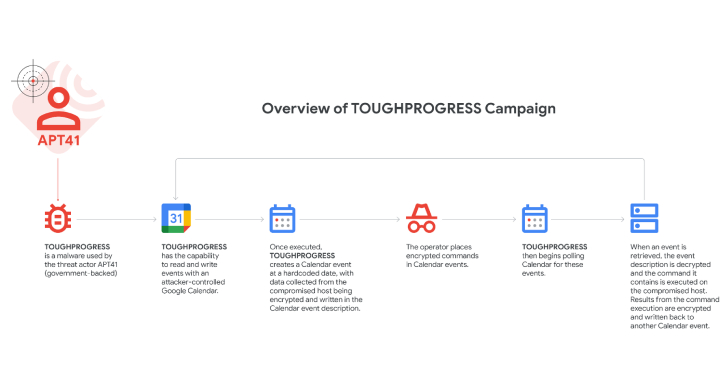
APT41, also known as Winnti, Barium, Wicked Panda, and Brass Typhoon, is a Chinese state-sponsored group known for blending espionage with financially motivated cybercrime. In 2025, researchers uncovered a new malware family, nicknamed ToughProgress, that uses Google Calendar events as its command center, hiding instructions and exfiltrated data inside calendar entries.
The attack begins with a targeted phishing email that links to a ZIP archive hosted on a compromised government website, lending the lure extra legitimacy. Inside the archive, victims find:
- A Windows shortcut (LNK) file pretending to be a PDF, which the user is tricked into opening.
- A payload file masquerading as a JPG image (6.jpg), which actually contains encrypted malware.
- A second “image” (7.jpg) that is really a DLL used to decrypt and launch the payload.
When the victim opens the fake PDF shortcut, it triggers the DLL (often called PlusDrop), which decrypts and loads the next stage (PlusInject) entirely in memory to avoid leaving obvious traces on disk. PlusInject then uses process hollowing against a legitimate Windows process such as svhost.exe, injecting the final ToughProgress malware into it so activity appears to come from a trusted system process.
Once running, ToughProgress connects to a hardcoded Google Calendar endpoint and looks for specific events whose descriptions contain attacker commands. These events can be hidden or obfuscated, and because Calendar traffic appears normal and uses a major cloud provider, traditional network defenses are less likely to flag it. After executing the instructions, ToughProgress writes the results back into new calendar events, giving APT41 a two-way, covert communication channel fully embedded inside Google Calendar.
This technique is dangerous for three reasons:
- It blends in with everyday cloud usage, making detection harder than traditional C2 channels.
- It uses multi-stage, in-memory execution and living-off-the-land tactics (legitimate processes, DLLs), which many legacy antivirus tools miss.
- It exploits trust in major SaaS platforms, forcing defenders to look beyond simple domain or IP blocklists.
Root Causes: How This Was Possible
APT41’s Google Calendar abuse did not rely on a single “magic” zero-day in Calendar itself; instead, it exploited a combination of human, technical, and strategic weaknesses.
Key causes include:
- Effective spear-phishing and social engineering. The initial ZIP is delivered via convincing emails and a compromised government website, which lowers suspicion among targets.
- Weak attachment and link controls. Organizations that allow ZIP archives and shortcut files with limited scanning provide an easy entry path for LNK-based attacks.
- Insufficient application control. The malware chain relies on running DLLs and shortcuts, and then abusing legitimate Windows processes for hollowing; weak application whitelisting or EDR coverage lets this succeed.
- Blind trust in cloud services. Many defenders focus on blocking unknown domains but treat traffic to Google or other big cloud providers as inherently safe, creating a blind spot for Calendar-based C2.
- Limited behavioral monitoring. Traditional, signature-based security tools often miss fileless or in-memory stages, where APT41 invests heavily to avoid detection.
APT41’s broader history reinforces why this technique is credible and dangerous. The group has repeatedly:
- Targeted healthcare, telecom, high-tech, and government entities for long-term espionage.
- Mixed state-directed operations with profit-driven attacks such as theft from gambling and gaming sectors.
- Used advanced tradecraft like supply chain compromise, DLL hijacking, and living-off-the-land binaries (PowerShell, WMIC) across multiple campaigns.
Seen in this context, Google Calendar C2 is simply the next evolution in their strategy of hiding in plain sight within widely used platforms.
Practical Prevention: What Organizations Should Do Now
No single control will fully stop a group as capable as APT41, but a layered security program can significantly reduce risk and impact. Defenses fall into several categories: hardening users and endpoints, securing cloud usage, and improving detection and response.

1. Strengthen identities, endpoints, and the network
- Multi-factor authentication (MFA). Enforce MFA for all users, especially admins and VPN users, to limit credential theft and account takeover that often follow initial compromise.
- Least privilege and segmentation. Apply least privilege to all accounts and segment critical systems (such as domain controllers, payment systems or production servers) away from general user networks, limiting lateral movement.
- Harden endpoints against DLL and script abuse. Use application control or allow-listing so only trusted executables and DLLs can run, and restrict script engines like PowerShell, WMIC and cmd where possible.
- Patch management and configuration baselines. Keep operating systems and applications up to date and follow secure baselines that disable unnecessary services and legacy components attackers commonly abuse.
2. Reduce phishing and file-based entry points
- Advanced email security. Deploy strong email filtering with sandboxing of attachments and links, focusing on ZIP archives, LNK files, and “image” payloads that behave suspiciously.
- User awareness training. Regularly train staff to spot targeted lures, especially emails referencing government or trusted institutions and urging users to open compressed attachments.
- Tight attachment and macro policies. Limit which file types can enter via email and enforce scanning or isolation for risky formats like ZIP, LNK, and macro-enabled documents.
3. Monitor cloud and C2-like behavior, not just domains
- Behavioral analytics for SaaS traffic. Implement user and entity behavior analytics (UEBA) to detect unusual usage patterns, such as servers or service accounts making high-frequency calls to calendar APIs or reading large volumes of events.
- Visibility into cloud apps. Use CASB or similar tools to log access to Google Workspace and other SaaS platforms, enabling detection when non-user processes interface with tools like Calendar in abnormal ways.
- Outbound anomaly detection. Monitor for abnormal outbound traffic, including unexpected connections to cloud services from systems that normally do not use them (e.g., backend servers suddenly talking to Google Calendar).
4. Enhance detection, threat hunting, and incident response
- Deploy modern EDR/XDR. Use endpoint detection and response tools that can catch in-memory execution, process hollowing, and suspicious DLL loading, rather than relying only on signature-based antivirus.
- Threat hunting with TTPs. Build hunts around known APT41 behaviors: LNK-based phishing, DLL hijacking, use of WMIC/PowerShell, and unusual use of cloud app APIs for C2.
- Incident response readiness. Maintain and rehearse playbooks for advanced persistent threats, including rapid credential revocation, system isolation, and covert remediation so attackers cannot see your defensive moves.
- Red teaming and simulations. Conduct realistic attack simulations to test how your people, processes, and tools perform against stealthy, multi-stage campaigns like APT41’s.
Future Strategies: Preparing for the Next Generation of State-Sponsored Attacks
APT41’s use of Google Calendar is a signal of broader trends: state-sponsored actors will increasingly weaponize benign cloud features, automate campaigns with AI, and blur the line between crime and espionage. To stay ahead, organizations and governments need to adopt more proactive, intelligence-led strategies.
1. Deeper collaboration with cloud providers
Cloud platforms like Google, Microsoft, and others have unparalleled visibility into abuse of their services, including Calendar and similar features. Future defenses should focus on:
- Shared telemetry and threat feeds. Enterprises consuming standardized signals from cloud providers that flag suspicious calendar or document events associated with known threat actor infrastructure.
- Joint investigation and rapid takedown. Playbooks where cloud providers and affected organizations can quickly disable malicious accounts, events, and API keys used for C2.
- Security-by-design in SaaS features. Designing collaboration tools with built-in abuse detection and anomaly patterns, instead of assuming they will only be used by legitimate users.
2. AI-driven cyber defense
Several government and industry bodies have emphasized the need to shift from reactive “damage control” to proactive, AI-powered cybersecurity. Over the next few years, effective strategies will likely include:
- Continuous anomaly detection at scale. Using machine learning to monitor billions of events across endpoints, identity systems, and cloud apps, flagging subtle patterns that resemble APT behavior.
- Automated response orchestration. Integrating AI with SOAR platforms so low-confidence alerts are enriched, and high-confidence signals trigger playbooks to isolate machines, rotate credentials, and lock suspicious cloud tokens in near real time.
- Adversarial simulation with AI. Leveraging AI to model attacker paths and identify which combinations of misconfigurations, unpatched systems, and exposed credentials would be most attractive to groups like APT41.
3. Unified national and sector-level strategies
State-sponsored attacks such as APT41’s campaigns are not just an enterprise problem; they raise national security and sector-wide resilience questions. Future strategies will likely emphasize:
- Cross-agency coordination. Ensuring government agencies responsible for cybersecurity share intelligence rapidly and work with private industry in a unified way, rather than in isolated silos.
- Sector-specific playbooks. Developing tailored strategies for high-risk verticals like healthcare, telecom, and gambling/gaming, which APT41 has repeatedly targeted.
- Clear accountability for foreign state actors. Strengthening legal, diplomatic, and economic tools to deter ongoing state-sponsored cyber operations.
4. Organizational mindset shift: assume compromise, design for resilience
Finally, enterprises need to accept that determined actors like APT41 may eventually find a way in, and design architectures that remain resilient even after initial breach. That implies:
- Zero trust architectures. Treating every user, device, and workload as untrusted until verified, making lateral movement far more difficult even if malware like ToughProgress runs on one host.
- Data-centric security. Encrypting sensitive data at rest and in transit, enforcing strong access controls, and monitoring data flows so exfiltration attempts via cloud channels are quickly spotted.
- Continuous improvement. Using findings from incidents, red team exercises, and sector intelligence to iteratively improve controls, policies, and documentation, rather than relying on one-off projects.
About the Author